Wednesday, March 01, 2006

1 in 1000 know the First Amendment

In popular American culture, the moron is upheld as an example to which people should aspire. In fact, an entire section of American culture is emphatically dedicated to the glorification of the idiot.

Case in point, A large portion of Americans know more about The Simpsons than they do the First Amendment.
The study by the new McCormick Tribune Freedom Museum found that 22 percent of Americans could name all five Simpson family members, compared with just one in 1,000 people who could name all five First Amendment freedoms.

I find it utterly appaling to see that people know more about an imaginary family than they do the basic freedoms upon which America was founded. This is also a gross indictment of our public education system, which is allegedly charged with ensuring our young have at least a basic knowledge of our rights and responsibilities in our society.

Appalling though this situation may be, I can't honestly say I'm surprised. This is something I've seen coming for some time now. Unfortunately, as it stands now, it looks as though it's only going to get worse.

Friday, February 17, 2006

Big Brother, Where Art Thou

Let's take a look at what Houston's Chief of Police would like to do:

Police chief wants surveillance cameras in Houston apartments

HOUSTON Houston's police chief is suggesting putting surveillance cameras in apartment complexes, downtown streets and even private homes.

Chief Harold Hurtt today said it's another way of combatting crime amid a shortage of officers.

Houston is dealing with too many police retirements, too few recruits and a population increase of about 150-thousand hurricane refugees.

Hurricane Katrina slammed the Gulf coast in late August.

Rita hit southeast Texas about one month later.

The Houston City Council is considering a public safety tax to pay for more officers.

Scott Henson with the American Civil Liberties Union calls Hurtt's proposal to require surveillance cameras as part of some building permits -- "radical and extreme."

Houston Mayor Bill White hasn't talked with Hurtt about his idea, but sees it as more of a "brainstorm" than a "decision."


Many of us in Houston pretty much expect the local cops to be corrupt and inept. In fact, the phrase "corrupt Houston police" is much like "crooked politician" or "raving moonbat"; it's simply redundant.

Take this in conjunction with Nicki's post, which I reproduced earlier, and taking a look at the manner in which cops all over the nation are acting, it's becoming even clearer that many police organizations see themselves above the concerns of the paltry and irrelevant rights of us mere citizens.

Emperor Mayor Bill White, best known by readers of this blog to be the orchestrator of the "Cars for Kickbacks" scheme known as SAFEClear, says this is only "brainstorming." I couldn't help but notice that every time Emperor Mayor White gets involved in brainstorming, those policies have a tendency to get passed into law without the subjects citizens ever being informed until the law has been passed.

It makes me wonder how long it will be until something like this gets passed, then how much longer until it's not shot down by the Supreme Court.

Update


HPD may add video cameras to its ranks

Feb. 16, 2006, 1:09PM
HPD may add video cameras to its ranks

Officer shortage leads city to look at surveillance of streets, malls — even some homes

By ALEXIS GRANT
Copyright 2006 Houston Chronicle

Facing a shortage of police officers, Police Chief Harold Hurtt called Wednesday for a new type of patrol: surveillance cameras on downtown streets, apartment complexes and shopping malls — and in extreme situations, private homes.

"If you're not doing anything wrong, why should you worry about it?" Hurtt told reporters.

His remarks came as the City Council approved a financial-incentive program to help the Houston Police Department recruit officers.

The department is struggling with a manpower shortage as well as a spike in violent crime. To supplement officers on patrol, HPD is considering installing five video cameras downtown, Hurtt said. He also suggested that new apartment complexes and malls be required, as part of the building-permit process, to provide security cameras.

And when asked whether the need for cameras extends to private homes, he said, "If they're putting a burden on the criminal justice system and cheating the other residents of Houston, yes."

He did not elaborate on how police would accomplish such surveillance or when it would be appropriate.

Source of funds
The downtown-camera project already has a group to fund it: the Houston Downtown Management District. Once the cameras are installed, the project would be carried out by HPD. Officers would monitor video feeds from a new storefront office planned for downtown.

"It's going to be a lot less expensive than having officers standing in those locations or responding to all those calls," said Hurtt, who wants to have the cameras up by the end of this year. "What we need is a combination of technology and human resources to deal with this issue."

The Downtown Management District, which works to improve the central business district using taxes paid by downtown property owners, has proposed five sites for cameras at intersections on and around Main. They are high-pedestrian-traffic, not high-crime, locations, said Bob Eury, executive director of the district.

Mayor must approve
"The goal is for people to feel safe," said Eury, who compared the cameras to those at shopping malls. "We're finding new ways to make it basically safer in reality and perception."

The program would cost tens of thousands of dollars, Eury said, declining to estimate more precisely since the project will be put out for bids.

The emphasis on new police and surveillance is part of the city's response to a recent spike in violent crime.

It was up 2.3 percent through November 2005, compared with the same period in 2004, though the overall crime rate was down 2.2 percent.

Mayor Bill White, who must approve the camera program for it to go into effect, said he had not yet discussed it with Hurtt.

"There's a legitimate right to privacy," White said. "On the other hand ... if there are some crime hot spots, then we want something where we don't have to have uniformed officers staring at a particular spot 24 hours a day."

The City Council's Committee on Public Safety and Homeland Security will consider the program Feb. 28.

Some privacy concerns
Some privacy advocates questioned whether apartment owners should be required to install cameras.

"It's radical and unheard-of," said Scott Henson, director of the American Civil Liberties Union's Texas Police Accountability Project.

But on city streets, it's a different story. Cities across the country, including Chicago, Los Angeles and Minneapolis, already use surveillance cameras in public places. In London, where cameras are commonplace, the technology helped police solve last year's transit bombings.

Technology isn't the only tool HPD is using to fight crime. The understaffed department hopes to entice experienced officers nationwide to work in Houston by offering a $7,000 bonus and increased pay under a program approved Wednesday by City Council. By hiring 700 new officers every year for the next three years, Houston would have 2.8 officers for every 1,000 people, the national average, instead of the current 2.2 per 1,000 people, Hurtt said.

Under the incentive program, HPD officers who have less than five years' experience will also get a pay raise.

Thursday, February 16, 2006

"I don't care what the laws or the Supreme Court say. WE are NOT going to have people running around, wearing guns..."

Cross posted at the Liberty Zone.

Mark Edward Marchiafava did not break the law in Gonzales, La. on January 28, 2006. But nonetheless, he was handcuffed, arrested, and his firearm, which he was legally carrying in the open on his side was confiscated and not returned.

I don't know Mr. Marchiafava very well. We have had several email communications, but nothing more than that. We have not always agreed, and sometimes our discussions got heated. But what I do know is that Mr. Marchiafava's right to keep and bear arms and his property rights were violated by the Gonzales, La. police.

When I deployed with the National Guard to New Orleans in support of relief and recovery efforts after Hurricane Katrina, I remember a meeting on an abandoned tarmac (where we slept the night before inside our humvee) with the Louisiana JAG. We were informed, in no uncertain terms, that open carry was legal in Louisiana, that we were there to help enforce the laws of Louisiana, and the law stated the people had a right to keep and bear arms. He were told that unless we witnessed a crime being committed, under no circumstances were we to relieve people of their firearms if they were carrying them in the open.

The Army and Air National Guard understand this. I wonder how brainless the Gonzales cops have to be to not get this simple concept.

In Mr. Marchiafava's own words:

After meeting my youngest daughter, Christie, and my adopted daughter, Kelly, along with Kelly's 2 year old daughter, Isabella, Kelly drove us to Gonzales, La. to visit my oldest daughter, Michelle. Needing to pick up something, I asked Kelly to drive into Tanger Factory Outlet. She dropped me off in front of the store, I ran in and out in less than 2 minutes while Kelly circled the parking lot.

While waiting to check out, I noticed an older guy standing right outside, staring intently at me. I KNEW he was either an off duty cop or he had just CALLED the cops on me. Yes, I WAS openly carrying a gun, which is quite legal in Louisiana. The state constitution CLEARLY states so. It does, however, retain the right by the state to regulate concealed carry, something that doesn't come into play here.

Sure enough, as I was paying, a Gonzales police car came cruising by slowly. After exiting the store with my purchase, I got into Kelly's car and within seconds, the cop turned on his lights and blipped his siren. Kelly exited and the cop told her it was ME he wanted to talk to.

Carefully, I approached officer Rome, and he asked why I was wearing a gun. After telling him EVERY citizen had that right, he just stood there, speechless.

I asked if he was aware of that, but STILL there was no answer.

It took THREE further queries before he finally answered, "No, I didn't know that."

Seemingly satisfied, he handed my driver's license back to me, and I heard him tell headquarters to print him out a copy of my driver's license info. At that point, I knew "they" were about to do "something." I got back into Kelly's car, not wanting to alarm them.

Sure enough, as soon as we exited the center's parking lot, FOUR Gonzales cop cars swooped in and, in true TV cop fashion, with guns drawn and lots of loud shouting.

I slowly exited the car, hands away from my side. Yes, I was roughly handcuffed to the point of having red marks on both wrists 3 hours later. I was transported to Gonzales Police headquarters. There, Officer David Breaux was trying to figure out just what to charge me with. Since he was holding Louisiana revised statutes, title 14 (criminal code) in his hands, I suggested he read 14:95, "Illegal carrying of weapons," which he did.

I tried, in vain, to explain to him there is nothing in the entire book which prohibits anyone from openly carrying a weapon in Louisiana.

His response: "Tell it to the judge."

Another "officer," Billiot, transported me across the Mississippi river to the jail in Donaldsonville. On the ride over, I tried to explain to HIM what the law states and the rights of any citizen.

He said, and I quote, "I don't care what the laws or the Supreme Court say. WE are NOT going to have people running around, wearing guns, with women and children everywhere."

I was fingerprinted, photographed and released on a $200.00 bond. Yes, all this for a MISDEMEANOR and a $200.00 bond. I am still trying to retrieve my gun at this date.

Now, let's take a look at what the law says.

Louisiana state constitution
Article 1 sec. 11 Right to Keep and Bear Arms
The right of each citizen to keep and bear arms shall not be abridged, but this provision shall not prevent the passage of laws to prohibit the carrying of weapons concealed on the person.

Louisiana Revised Statutes
Title 14 sec. 95
Illegal Carrying of Weapons
A. Illegal carrying of weapons is:
(1) The intentional concealing of any firearm, or other instrumentality customarily used or intended for probable use as a dangerous weapon, on one's person, or
(2) the ownership, possession, custody, use of any firearm, or any other instrumentality customarily used as a dangerous weapon, at any time by an enemy alien, or
(3) the ownership, possession, custody or use of any tools, or dynamite, or nitroglycerine, or explosives, or other instrumentality customarily used by thieves or burglars at any time by any person with the intent to commit a crime ; or
(4) the manufacture, ownership, possession, custody or use of any switchblade knife, spring knife or other knife or similar instrument or having a blade which may be automatically unfolded or extended from a handle by the manipulation of a button, switch, latch or similar contrivance.
(5)(a) the intentional possession or use by any person of a dangerous weapon on a school campus during regular school hours or on a school bus. "School" means any elementary, secondary, high school, or vo-tech school in this state and "campus" means all facilities and property within the boundary of the school property. "School bus" means any motor bus being used to transport children to and from school or in connection with school activities.
(b) the provisions of this Paragraph shall not apply to:
(i) a peace officer as defined by RS:14:30(B) in the performance of his official duties.
(ii) a school official or employee acting during the normal course of his employment or a student acting under the direction of such school official or employee.
(iii) any person having the written permission of the principal or school board or engaged in competition or in marksmanship or safety instruction.


United States Code, title 42, chapter 21, subchapter I, sec. 1983
Civil action for deprivation of rights
Every person who, under color of any statute, ordinance, regulation, custom or usage, of any state or Territory or the District of Columbia, subjects, or causes to be subjected, any citizen of the United States or other person within the jurisdiction thereof to the deprivation of any rights, priviliges, or immunities secured by the Constitution and laws, shall be liable to the party injured in an action at law, suit in equity, or other proper proceeding for redress, except that in any action brought against a judicial officer for an act or omission taken in such officer's judicial capacity, injunctive relief shall not be granted unless a declaratory decree was violated or declaratory relief was unavailable. For the purpose of this section, any act of Congress applicable exclusively to the District of Columbia shall considered to be a statute of the District of Columbia.


UPDATE FEB. 6TH, 2006

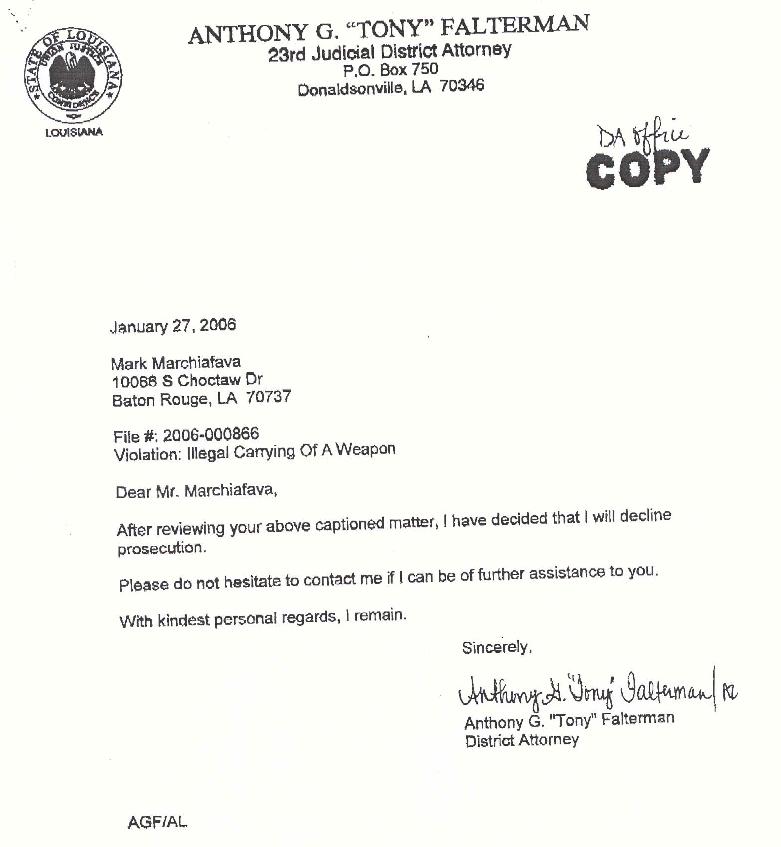
District Attorney, Tony Falterman, obtained a copy of the arrest report and, after reading it, dismissed the charge. According to his assistant, Melissa, "Mr. Falterman has read the report and considers it complete BS."

A local reporter, Steve Ward with the Advocate, contacted chief of police Bill Landy concerning my arrest. According to Steve, the chief stated "We have a policy of arresting anyone carrying a gun without a permit. We don't care what Mr. Falterman says or does."

I attempted to retrieve my gun, only to find out the Gonzales police department has a "policy" of sending all seized weapons to the state police crime lab for ballistics testing.


So let's get this straight. A man broke no law. He is arrested. His property is confiscated. The prosecutor recognizes this case as complete crap. The police will not give back property, even though no crime was committed.

Check out the letter Mr. Marchiafava received from the prosecutor in the case below.


What kind of circus are they running down there in Gonzales?

Should you want to contact the fascist nazis on Mr. Marchiafava's behalf -- and on behalf of our constitutionally guaranteed rights -- please do so. The Gonzales Police Chief's name is Bill Landry. You can email him here: gonzpd@eatel.net

Or if you're feeling particularly angry about this, give him a call and demand to know why a man who has committed no crime has been relieved of his property by his tyrannical staff, and why his officers have no respect for the laws they have sworn to enforce. His number is: 225-647-2841

Sunday, February 05, 2006

When will it end?

LONG BRANCH, N.J. - The city wants Anna DeFaria's home, and if she doesn't sell willingly, officials are going to take it from the 80-year-old retired pre-school teacher.

In place of her "tiny slip of a bungalow" — and two dozen other weathered, working-class beachfront homes — city officials want private developers to build upscale townhouses.

Is this the work of a cruel government? Or the best hope for resurrecting an ocean resort town that is finally showing signs of reviving after decades of hard times?

Echoes of the debate are happening across the country, after a U.S. Supreme Court decision brought new attention to governments' ability to seize property through the tool of eminent domain. Some 40 states are re-examining their laws — with action in Congress, too — after the court's unpopular ruling.

"We thought this was going to be our home forever," said DeFaria, sitting in a kitchen cozy with photos of children and grandchildren, quotes from the Bible and a game of Scrabble that she plays against herself. "Now they want to take it away. It's unfair, it's criminal, it's unconstitutional."

Not according to the Supreme Court. In a 5-4 ruling last June that was greeted with widespread criticism, the court found that New London, Conn., had the authority to take homes for a private development project.

The Constitution says governments cannot take private property for public use without "just compensation." Governments have traditionally used eminent domain to build public projects such as roads, reservoirs and parks. But for decades, the court has been expanding the definition of public use, allowing cities to employ eminent domain to eliminate blight.

The high court, in its ruling, also noted that states are free to ban that practice — and legislators around the country are thinking about whether they should do just that.

New Jersey state Sen. Diane Allen, with bipartisan support, is pushing for a two-year ban on all eminent domain actions and for a bipartisan study group to re-examine its use in New Jersey.

"Right now government, I think, is using eminent domain to take people's private properties and hand it over to another owner," said Allen, a Republican. "It's really putting a hole in the American dream. Ownership of private property plays such a large role in that dream."

After the court ruling, four states passed laws reining in eminent domain. Roughly another 40 are considering legislation. In Congress, the House voted to deny federal funds to any project that used eminent domain to benefit a private development, and a federal study aims to examine how widely it is used.

The Washington-based Institute for Justice, a libertarian advocacy group that worked for homeowners in the New London case and in Long Branch, argues that state laws should be changed so property can only be seized for public uses like a park or a school — not urban redevelopment that benefits private developers.

Redevelopment usually depends on defining an area as "blighted" or a "slum," though definitions are vague, said Bert Gall, an attorney with the institute. Criteria can include a building's age, lack of compliance with building codes, even the size of a yard.

Abuses are widespread, Gall said, claiming that over a five-year period ending in 2002, more than 10,000 properties were threatened by eminent domain.

Municipal leaders across the country are pushing back, arguing that it's false to claim eminent domain is widely abused and warning that an emotional backlash to the court ruling is putting at risk an important tool that has helped turn around neighborhoods including Baltimore's Inner Harbor and New York's Times Square.

Elected officials have difficult decisions to make, and often must balance a community's needs with a few individuals, said Don Borut, executive director of the National League of Cities.

The plight of homeowners is hard to ignore, he said. "But at the same time ... there are hundreds if not a couple of thousand faces of people you don't see, of people of all levels of income who as a result of the economic development will get jobs," he added.

In Long Branch, there's no doubt the city needed to do something — a comeback wasn't happening on its own, Mayor Adam Schneider said.

"Most people wouldn't walk down those streets anymore. The worst neighborhood in our city was along our oceanfront. And that's been reversed," he said. Since the redevelopment effort began in earnest in 2002 after a decade of planning, new shops and homeowners have moved in, and new sidewalks have been installed — along with a new boardwalk, parks and an ice-skating rink, he said.

"What you do is you've improved your city, you've gotten rid of decrepit housing, you've created jobs," Schneider said. "It's easy to play it out as the city is cruel and government is stealing your property. I'm used to it. ... But this has reversed the decline that's been going on in Long Branch for more than 50 years."

Already, people are coming to new shops along the central waterfront, where the old pier burned down back in 1987. Rows and rows of new, sand-colored condominiums shadow DeFaria's one-story home when the afternoon sun sinks low.

DeFaria said she was offered $325,000 for the home she and her late husband bought in 1960 for $6,400. Where could anyone buy a waterfront view on the Jersey coast for that amount of money now?

But it's not the money, she said: $1 million wouldn't convince her. "They're taking my home away — not my house. My home. My life."

Tuesday, January 31, 2006

Oh, No! College Kids Are Still Drinking!

University of Massachusetts, Amherst wants to make some new rules to curb college drinking.

UMass Imposes More Drinking Restrictions

Jan 31, 7:08 AM (ET)

AMHERST, Mass. (AP) - No more drinking games at the University of Massachusetts. The school is cracking down on alcohol abuse on the Amherst campus with a list of new rules that go into effect this semester.

Along with banning games meant to get players drunk as quickly as possible, the rules include prohibitions on taps and funnels and large gatherings where more than 10 people are in a dormitory room with alcohol.

There will also be fewer bottles of beer lined up on the dorm room walls. Students who are 21 or older will be allowed to keep no more than 12 bottles or cans of beer, two bottles of wine or one bottle of hard liquor.

"These changes represent our continued efforts to reduce underage and binge drinking," said Jo-Anne Vanin, dean of students.


I suppose someone sees this as sensible. I sure the hell don't.

Now one thing that surprises some people about me is my attitude about college drinking. One would naturally assume that such an outspoken and enthusiastic lover of fermented beverages such as myself would come out in favor of college drinking shennanigans, and in the end their right, but not for the reasons one might think.

I actually despise the way people drink in college. I really can't stand such dilletantishness as keg stands, beer bongs, and shotgunning. I mean that's some childish shit right there. Even when I was in college I hated that shit. And believe me, at a small, Baptist university where any drinking is frowned upon, that's about all the drinking you see, albeit a little more surreptitiously.

If you wanna get smashed, don't just dump 5% ABV American "sex in a canoe" beer down your throat with a hose. Instead, crack open a bottle of Bourbon or vodka and mix a proper drink. If you drink at all, it should be because you like to drink, not to prove your manhood or try to fit in or some shit. If you're feeling insecure about whether or not all the cool kids will like you, I'm here to tell you the booze ain't gonna help.

What it will do, however, is remove your inhibitions which are preventing you from doing the stupid shit you are likely to do because you've got something to prove. Contrary to what we've all been spoon-fed, alcohol does not make you do something you don't want to do. It simply lowers the inhibition. If someone is going to make an ass of themselves, the booze will simply remove the inhibition and it's only a matter of time. Even if they do get through it all unscathed, they'll blame the booze in a bad way and end up further propagating the prohibitionist paradigm more effectively.

"See kids," The reformed college "alcoholic" says, "alcohol is bad for you. It made me sleep with all those frat boys and get AIDS. It made me drink that flaming shot and get third degree burns all over my face. It made me jump across that bonfire and break my legs. It made me do all those kegstands because I wanted to impress my buddies and drive home and wrap my car around a telephone pole."

I mean just look at our President. There's a man who needs to come out of the drunkard closet if I ever saw one. But that's another rant, and as we say in the tech support monkey business, "outside of the scope of this document."

My fellow drunkards and I refer to that as Amateur Hour. You get these young kids that are too young to remember when the martini lunch was de rigeur among professional types, or when you could drive home after having a glass of wine with dinner and not have to worry about random checkpoints. These people don't have any cultural experience with drinking, so their drinking is amateurish and irresponsible. They end up hurting themselves and in some cases dying before they ever can learn how to drink properly.

I feel sorry for them. You have an entire subculture of people who are the victims of neoprohibition. They've been fed all the stock bullshit about how alcohol is nothing but bad, and that if you so much as have a beer, your life will spin out of control and you will become a raging alcoholic and be a failure at life. I guess that these people figure that since they are "breaking the rules" then they might as well give up all control.

That way you end up with DUI's, wrecked academic careers, and the occasional death from alcohol poisoning, "a promising youth cut down in his prime," as the cliche goes. These people are victims of neoprohibitionism and a nannying society which rules us all to death and makes criminals of the innocent.

In the wake of this, of course, the response is to make more rules. There's a sensible solution. [/sarcasm]

Now keep in mind that for most of these milquetoast neoprohibitionist harpies, the definition of binge drinking is at least two drinks a day. Ironicly, this is the same amount that most doctors recommend as a minimum to help prevent heart disease, lower blood pressure, and a whole other laundry list of things that doctors have recently determined that moderate alcohol intake is good for (and that sensible people have known that alcohol is good for since ancient times).

So with that mindset at work you have all these petty little regulations being implimented, which I'm sure will not even make a dent in the amount of binge drinking, either real or imagined, that goes on in college campuses. While the amateurish style of drinking does create problems, there are still plenty of folks going to college who don't have these problems. But screw it, let's just punish the whole lot for the sins of a few. And while we're at it, let's use the sins of those few as anectodal evidence to support more manufactured statistics and create more unnessesary rules.

Now I know some of you are reading this and going, what does this have to with Constitutional rights?

Well, I could argue that this subculture and these kinds of rules tie into a larger neoprohibitionist effort perpatrated by those who've been collectively undermining the Constitution since 1983. While that might be valid that's not why I chose to post this here.

What irks me specificly is that the University of Massachussets system is a public school which recieves funding from the State of Massachussets. As such they have to adhere to that annoying little document called the Constitution just like any public body. And if you live in the State of Massachussets, you're paying taxes for this shit.

You see there's this little amendment to the constitution, the 21st in fact, which specicicly repealed the 18th amendment prohibiting alcohol. Oh, bother, say the prohibitionists. Many argue that, failing the direct approach constitutionally, prohibitionists are passing lots of small laws that result in the end goal of prohibition anyway. But there's also the 1st Amendment:

Congress shall make no law respecting an establishment of religion, or prohibiting the free exercise thereof; or abridging the freedom of speech, or of the press; or the right of the people peaceably to assemble, and to petition the Government for a redress of grievances.


Now look at this bit from the article:

Along with banning games meant to get players drunk as quickly as possible, the rules include prohibitions on taps and funnels and large gatherings where more than 10 people are in a dormitory room with alcohol.


It seems to me like college students getting together for the purpose of drinking in a legal fashion constitutes peaceable assembly. Not only does the University policy violate the letter of the Constitution, I believe it violates the spirit of what the framers had in mind. Consider that in the time the Constitution was written, the drinking tradition was much stronger in this country. Every single one of the authors of our Government went out drinking at night. The idea that a hardworking, churchgoing, responsible American wouldn't drink would was ridiculous to them.

These college students who are drinking in their dorm rooms aren't there to engage in sedition or to incite violence, they're there to get their drink on. As long as it's legal (IE: everyone is over 21, etc.) There's no reason for that sort of rule.

Or more appropriatly, I should say there's not excuse for that rule.

Friday, January 20, 2006

Yes, GOP, I'm looking at *you*

Once again, the ministrations of representatives of the so-called "party of small government" proves that it has abandoned the principles of Ronald Reagan.

Man awarded $1 for 105 acres Port condemned

By: DANA BURKE, Citizen Staff01/19/2006

For years, Seabrook residents have said building the Bayport container facility north of town would hurt property values.

They might be surprised at how much one man got for his tract of land - $1 for 105 acres.

Pasadena land owner Glenn Seureau, II, thinks he was robbed of his by the Port of Houston Authority. He plans to continue an uphill battle with the Port until he is paid fair market value for the land.

One civil court judge, on the other hand, seems to think $1 is compensation enough for Seureau's land, located just north of Seabrook.

Seureau fought for nearly three years to protect his property, in his family for more than 150 years, from the Port's power of eminent domain, only to lose his case in May of last year in the court of Harris County Civil Court Judge Lynn Bradshaw-Hull.

The judge ruled that having paid Seureau $1, the Port now owns the fee simple title to the property. Seureau was also ordered to give back the Port's previous payment of more than $1.9 million at 5.75 percent interest and pay the Port's court costs at the same interest rate.

Seureau has appealed the ruling, and he and his attorneys are currently in negotiations with the Port.

Port officials declined to comment on the case, but confirmed that they are working with Seureau to reach an agreement.

The conflict began in September 2002, when a special commission held a hearing regarding the Port's request to condemn Seureau's land. Seureau did not attend the hearing, and the commission ordered the Port to pay him approximately $1.9 million for the property.

The Port deposited the funds into the registry of the court, taking constructive possession of the land, but Seureau refused to take the money or relinquish the title to the property.

"I didn't think (the Port) had the right to take the property," he said, adding that the Port's need for the land seems to be based on private rather than public interests.

The Port plans to build a portion of the Houston Cruise Terminal on the property.

Seureau also believes $1.9 million is less than the market value for the land, which he had planned to develop with multi-family residences.

He was later advised by an attorney that he did not have the right to contest eminent domain and withdrew the $1.9 million to pay for further appeals regarding the market value of his land.

The Port brought Seureau to Bradshaw-Hull's court on May 16, 2005 to obtain the fee simple title that Seureau had withheld until that point.

On May 17, the judge excluded the testimony of both Seureau and his only expert witness, Louis Smith, saying that neither man could provide evidence that was relevant or reliable regarding the market value of Seureau's land.
According to court documents, the judge's final ruling was based on a lack of evidence to support Seureau's argument.

Seureau also made a motion to exclude the testimony of one of the Port's expert witnesses, Matthew Deal. The court denied that motion.

Seureau, who lives in his 180-year-old family home next door to the recently condemned property, said that although he is not familiar with the judge's intentions, he sees Bradshaw-Hull's ruling as a "punishment" for trying to challenge the Port.

"I was forced to settle for less than market value," he said.

Bradshaw-Hull declined to comment on the case since it is on appeal.

Judge Bradshaw-Hull is seeking reelection on the GOP platform.

Monday, January 16, 2006

Kelo in action

Back when the US Supreme Court (thanks to Swinging Sandra O'Connor) decided in Kelo that government can seize private property from its current owner and transfer the property to another private party in the name of economic development, many of us predicted that abuses were sure to follow. Yours truly, for example, wrote a TCS column, in which I opined that:

After news of Napoleon's victory in the Battle of Austerlitz was conveyed to British Prime Minister William Pitt, Pitt pointed to a map of Europe and said: "Roll up the map; it will not be wanted these ten years." In light of the Supreme Courts decision to side with New London, we might just as well roll up the Takings Clause of the Bill of Rights, because we won't need it any longer.

Regrettably, confirmation of my concern comes from my own home town: In the sort of blatant move one associates with the Soviet kolkhoz process, Los Angeles City Councilman Bernard Parks (our feckless ex-police chief) wants to the city to sell property seized to build a badly needed animal shelter funded by a city bond approved by the voters to a politically well-connected developer (Francisco Pinedo, president of Cisco Bros.) who has made campaign contributions to Parks and other top city officials. The LA Times reports:

The city's initial plan was to use the site for a new South Los Angeles animal shelter. The city paid $5.8 million to buy the property with money raised by a bond issue that voters approved to expand animal services. ...

Councilman Bernard C. Parks, who is spearheading the plan and represents the area, says the public would benefit more if the land were used for a business. ...

The previous owners of the property, which includes three warehouse buildings, said the city has betrayed them. Their furniture-manufacturing firm had 20 years of success in South Los Angeles, said Scott Vaughan, a partner in Vaughan Benz, which has moved to near Chinatown. "It was thriving." "If they are not going to do what they claimed they were doing and put an animal shelter there," he said, "it was unnecessary to take our property." Vaughan Benz fought the city's decision to seize its property in court, and the partners said the time and money spent on that battle hurt their business.

This is the worst sort of abuse of the eminent domain process, in which a private property owner gets screwed of its land so that a wealthy and politically-connected developer can make money.

But the problem is compounded by the involvement of the voter-approved bond fund:

"I really do feel uncomfortable about it," said James W. Odom, a member of an oversight committee set up by the city to make sure it properly spends the money from its animal shelter bond issue. If the city decides to change the property's use, Odom said, he will fight to make sure the animal shelter bond money is paid back. ...

City sources ... said the income from the sale is unlikely to fully pay back the $8 million spent so far from the animal shelter bond, which includes the legal costs of acquiring the property through eminent domain and $1 million in already completed design work.

Put bluntly, this reeks of corruption. If the deal goes forward, there needs to be an investigation to determine whether Parks violated the law. Ironically, however, city attorney Rocky Delgadillo has gotten even more money in campaign contributions from developer Pinedo!


Is there ANYONE out there who could not have predicted that our property rights would eventually be at the mercy of those with enough dough to bribe corrupt politicians?

Thursday, January 05, 2006

You Say You Want a Revolution? Well, Alright.

If you look closely at the rights extended to us by the US Constitution, you will realize that several of them are not just rights, they are the duties of free peoples. This is because the very EXERCIZE of those specific rights helps us maintain them and all other rights. The first two amendments of the constitution stick out foremost in my mind -- by worshiping as we see fit, we are reminded that our rights are endowed to us by our Creator, not the whim of the state. It is by speaking freely that we keep the flame of freedom lit in the hearts and minds of our fellow citizens, and it is by assembling that we can communicate and coordinate any and all efforts to protect our freedom.

But the second amendment is even more essential, for an unarmed populace is powerless to do anything to protect itself or its freedoms except to call upon and trust in the good graces of the powerful. That is not a bet I care to place. You see, while I do not intend to downplay the usefulness of firearms as a way of securing food (hunting) or self-defense, I believe, as many of us on the right do, that the core purpose of the Second Amendment is to protect us all from Tyranny -- and not just to arm the military to proterct us from foreign tyrrany, but to arm the populace against domestic tyrrany. The Founding Fathers had taken up arms in such a cause once, they intended to provide for the possibility of a repeat performance in the future.

I came to the above realization while pondering the recent brouhaha regarding the Christmas Cross that Lars Larson was planning. At least on poster at Portland IndyMedia made comments fantazizing about doing bodily harm to Lars. I supported Lars' decision not to go through with the cross raising, believing he had taken the moral high ground. But two things about the incident struck me: One was that I found it highly ironic that those on the Left (Let's be clear here, I'm not talking about liberals, I'm talking about THE LEFT -- people whose politics make Howard Dean seem centrist) would call Lars a Fascist and in the same breath threaten violence to silence him. But while I was bemused, I was not surprised.

The Left's fringe has become stronger, louder, and more openly embraced by the "Party" in general. And it's become apparent to anyone paying attention that the Left is becoming more and more comfortable with the idea of doing anything they must to further their views, including using violence and lawlessness. They also seem more than willing to do what they must to silence the expression of opinions contrary to their own. And while they might believe they are "Freedom Fighters", they are striving for a political and social order that is frighteningly oppressive in its tolerance of personal freedom. It seems more and more apparent that what the Left wants is Revolution, or at least Civil War. Case in point, note the tone taken by the reader "Unapologetic Liberal" in the comment thread of this post at Ace of Spades HQ.

But the left may be biting off more than they can chew.

This was the second impression I got from the Christmas Cross incident. As one conservative (I can't remember who or where) pointed out that this would be unwise, ever since a leftist idiot revealed Lars' home phone number at Michael Moore appearance and Lars began receiving death threats, Lars has had a CCW permit and actively exercizes his Second Amendment rights. While Lars decided to back down to prevent violence, if any of the PDX IM crowd really tried to do Lars bodily harm, I'm sure they would regret it -- if they lived.

There's a lesson about the Right to be learned by the left from that angle to the story, just as we are learning about them from their reaction. You see, while there is a fringe element to both sides of the political spectrum, it seems that in recent years, the Right has more and more marginalized its fringe, distancing ourselves from it, rejecting its extremes in a way that the Left has failed to react to their fringe. And while it's popular to cast the Right in the light of being the oppressors, we have for the most part shunned violence and domestic unrest as a means to our ends. We have tried to take the moral high ground, abide by the law, distance ourselves from unscrupulous allies and distinguish ourselves from unscrupulous adversaries.

But we can only be pushed so far. And if we find ourselves in a position where our own ability to push back is all that stands between us and being overrun by those who wish to oppress us, we will push back -- and our push is harder. We strive to uphold and respect the Rule of Law. But if you finally get what you want, if you achieve revolution in the streets and open conflict between us, remember this: We're the ones who believe in and exercize our right to bear arms as a means of protecting our other rights. Usually that means from the random criminal who would mug or rob or rape us or our families. Strategically that means from a tyrant who would invade our country from without. Theoretically, the Framers believed it could mean from a corrupt government that would usurp its authority from within. But make no mistakes. If you try to impose a Marxist order on us through violent overthrow of the Government, we are highly likely to decide that you are a greater threat to our freedom than the Government ever could dream of being.

And you won't like what happens when we take sides.

Monday, December 19, 2005

Good Collumn and Some Ranting About Neoprohibition

JD Bruewer of limaohio.com has a rather nice bit about neo-prohitionist legislation.


Prohibition is political dead meat. Enter neo-prohibition, a lighter, more palatable dish.

Calls for prohibition elicit strong reaction from many sectors of the public, but who can object to protecting children and innocent drivers? Neo-prohibitionists use these causes to criminalize and stigmatize all alcohol-related activities.

How can you object to tougher drunken driving laws or restricting the sale of alcohol around children? What politician would come out in favor of drunken driving or jeopardizing children?

With this approach, neo-prohibitionists have pushed the implementation of extreme laws that limit the civil rights of citizens accused of using alcohol improperly, while proving ineffective at protecting the public.

In a October column on FoxNews.com, Radley Balko, who runs the Weblog www.TheAgitator.com, details how Mothers Against Drunk Driving has morphed into a neo-prohibitionist group and how the .08 blood alcohol limit law the group promoted has failed to curb drunk driving.

“When two-thirds of alcohol-related traffic fatalities involve blood-alcohol levels of .14 and above, and the average fatal accident occurs at .17, this move doesn’t make much sense. It’s like lowering the speed limit from 65 to 60 to catch people who drive 100 miles per hour,” Balko writes.

He points out that the U.S. Government Accountability Office’s review of drunken-driving data concluded, “The evidence does not conclusively establish that .08 BAC laws by themselves result in reductions in the number and severity of crashes involving alcohol.”

If you want to read Balko’s writings on the subject, or the GAO report on .08 blood-alcohol content laws, go to www.LimaNews.com/neo-prohibition.

My point is, if you’re against legalized alcohol, say it, fight against it and be clear in your intention.

Don’t confuse the issue by tying it to bad, feel-good legislation. Don’t harm legitimate efforts to protect the driving public and children by hijacking their causes to support your own.

If you are for legalized alcohol, stand up for the right to drink, don’t let the neo-prohibitionists strip away your rights.


So in other words, shit or get off the pot!

I, like the author, know which side I am on regarding this issue. Drinking is legal. It should have never been made illegal. Having been made illegal, the only correct thing to do was to repeal the Constitutional amendment that made it illegal, which was done. With prohibition, as wrong as it was, you see a good example of people working within the law to amend the constitution properly within the correct framework, more or less.

Unfortunately, any above the board legislation concerning alcohol ended with the repeal of prohibition, when it became clear that American public would not as a majority support a minority position such as prohibition. Since then the vocal minority in this country has used every underhanded tactic they could think of to keep people confused and sitting on the fence regarding this issue.

In other words, the Drys couldn't defeat the American drinking public with a frontal assault, so now they are going for the flank. They couldn't win by preaching. They couldn't win by violence (such as was perpatrated by Carrie Nation and the Anti-Saloon league). They couldn't win by the legal high ground of the US Constitution. So now they want to undermine that Constitution to get what they want.

Let me stress that again. Regardless of the motive, which itself isn't entirely clear, the people who want to prohibit the consumption of alcohol now choose to undermine the Constitution because they couldn't manipulate it to get whay they want. They don't want anyone to drink, and they will take away that right any way they can. And they don't care if the rights of due process, fair trial, freedom from unreasonable search and seizure, and even the basic right of a mother to care for her child are compromised, so long as they get what they want.

And it's working, because they've been slowly softening and shifting the public perception of drinking and drinking issues for decades. They will fail if the American public stops and thinks about what is going on. They will fail if Americans question their own opinions and even perception of the facts on this matter. Even if you don't drink, at least be aware of what's going on because you have as much to lose as any drinker.

Here are a couple of facts that everyone seems to have forgotten. It's not illegal to drink in the United States. It's not even illegal to drink and drive (although the neoprohibitionists have managed to confuse us on that issue enough to where even most police officers no longer understand this simple fact).

Think about that for a second. It's not illegal for you to drink and drive. It's illegal to be intoxicated while driving, as you endanger yourself and others. The definition of that intoxication has been (innapropriatley) set as having a BAC of .08 in most states. Also, it's a very good idea to not drink and drive, one which I continue to endorse even when it means I'm not going anyhwere for a while. But if you drink and drive, you have not broken the law unless you've had enough to bring your BAC up to .08 or higher.

If you had a glass of wine with dinner and drive home, you have not broken the law, even though you might get arrested for it. If you are sleeping it off in the back seat, you have not broken the law, even though you might get arrested for it. If you are sitting at a bar drinking while your car sit in that bar's parking lot, you have not broken the law, even though you might get arrested for it. If you call a cab because you've been drinkinand don't wish to endanger yourself and others by getting behind the wheel, yet before you get into the cab you go into your car to fetch some of your belongings, you have not brokent the law even though you might get arrested for it.

Neo-prohibitionists don't want you to be aware of these facts. Instead they want you to have a fuzzy, inarticulate perception about drinking. And while they are at it they want you to be so afraid of criminall persecution and prosecution that you will stop drinking altogether.

"Drinking is not a crime."

Thursday, December 01, 2005

No Wonder We're Losing Our Rights

We're being conditioned to give them up in school.

In Lowell, Mass., a girl is sent home for wearing camo.

FATIGUE FLAP: LHS student sent home for wearing camouflage outfit

By HILLARY CHABOT, Sun Staff
Lowell Sun

LOWELL -- Shilo Lewis just wanted to blend in with the crowd.

She'd seen camouflage clothing in fashion magazines, on the streets of the city, even in Lowell High School.

But a head-to-toe camouflage ensemble got the high-school junior sent home from school yesterday.

“They took one look at me and said, ‘You have to get picked up,' “ Lewis said about school officials.

Lewis, 16, was wearing a camouflage bandana holding her waist-length hair in a ponytail, a camouflage jacket over a camouflage T-shirt, and a pair of camouflage pants.

“I think she looks great,” said her mother, Bette Lewis, who bought her the outfit. “She always looks nice. She always matches everything.”

Lowell High Headmaster Bill Samaras said military gear is associated with some local gangs, and could disrupt students' safety and their learning environment.

“This has nothing to do with the military. We allow Reserve Officer Training Corps to wear military gear because they wear it in a respectful manner. It's the gang relation. If it's controversial or if it has gang associations, we won't have it,” Samaras said.


This bothers me on two fronts. First, I'm a Navy brat and I've been wearing my old man's dungaree cutoffs, field jackets, and old BDU's since I was about 12. I carried my schoolbooks in seabags, field packs and bags purchased overseas while the old man was on liberty. This was the style in the 80's as it is now, but even if it wasn't, I and my fellow brats would have done it anyway because it was a part of our subculture, just as much having gray blankets that say "US" folded at the foot of our beds and putting olive drab batteries in our Walkmans and boom boxes. By time we reached late elementary school age, these things were a source of pride for us, and our parents were usually hip to it.

God help any school administrator that told one of us we couldn't wear camo to school. The general attitude among our parents was "I didn't fight for my country in Vietnam (or wherever) just to come and have my kids told they can't express themselves." They may not have always understood our fashions, but most military parents respected them because they realized that long hair or denim jackets with spikes or hip hop gear were a source of pride for one's specific peer group and that they indicated that we were taking pride in our appearance. These were values that my dad at least wanted to instill, even if the aesthetics were different than what he was used to.

Second, this shows either supreme ignorance or supreme malevolence on the part of the admistrators regarding the culture of their students. Here's a quick lesson. Gang members tend to wear baggy khaki's, plain white shirts or gear from athletic teams, and of course, their colors. The reason that they wear that sort of thing is so they don't stand out, except as a member of their gang. They wear baggy pants, of course, to conceal weapons. But their clothing is plain and uniform in order to both blend in and to deny a usable description to the police. When a gangbanger holds up a liquor store or commits a driveby, and the cops ask for a description from the victim, what they get is "a black male, average height, average build, wearing khaki pants, and a white t-shirt," or "a hispanic male, average height, average build, wearing a plaid shirt and a blue headband". Of course when the cops in South Central LA or East Houston go to look for the suspect, they see about a hundred people matching that exact description. It's kind of like going to a heavy metal show and saying, "have you seen a guy with long hair and a black t-shirt?"

Camouflage, of course, defeats that purpose because it stands out. Sure it's designed to conceal and break up one's outline in the field, but as youth fashion in an urban or suburban environment it's supposed to stand out. That's why it's worn. Kid's wear camo because they want to look cool and identify with other kids who share the same sense of aesthetics and cultural identity. There's nothing wrong with that. It is, in fact, constitutionally protected free expression.

Of course part of the problem is ignorant administrators confusing gang culture with hip-hop culture. Hip Hop culture often includes camo and all black attire, but it also includes visual elements taken from gang culture, such as the extremely baggy pants. Regardless of what someone thinks of kids wearing baggy pants halfway down their asses (which I personally think looks stupid), it doesn't equate to being in a gang. Administrators are simply making a spurious connection that has no basis in fact.

To use their logic, I must be a gangster because I wore a pair of khaki's to my business casual office job the other day. Never mind I was also wearing a company polo shirt and some dressy moccasins, because khaki's are associated with gangs therefore I must be a gangster. It's a handy excuse for malevolent or racist administrators to persecute students they don't like.

But there's more.

In Winona, Minn., Students are being punished for wearing"Bondage Pants". Now before I post the text of the article, let me explain what the hell these things are because I know some of you are scratching your heads. Bondage pants are basicly baggy pants, usually black, with a lot of zippers and straps and shit hanging off of them. Supposedly they are used in BDSM sex play as you can use the straps to tie the wearer up. thus the term "bondage pants." Now, I know some people who are heavy into lifestyle BDSM and I've never seen them wear bondage pants. Those folks usually prefer leather. But regardless, these pants are common among goth, punk, and metal subcultures because they are usually black and they look cool.


Minn. high school bans 'bondage' pants
November 29, 2005

WINONA, Minn. --Winona Senior High School has prohibited students from wearing a certain style of baggy pants because of safety concerns.

"Bondage" pants -- pants with several straps that hook from each back pocket to the opposite pant leg -- were banned about a month ago. The school's dress code committee decided that students shouldn't wear any strap that could be unsafe, whether made from chain or fabric, said associate principal Jeff Sampson.

Although the straps haven't caused any injuries at the school, Sampson said they could possibly hook students onto something or someone and would be especially dangerous around shop class equipment.

Junior Ed Chick and his friends said the straps would rip off the pants once caught and most are too high off the ground for others to trip over.

Students said the new prohibition is aimed at groups who some label as "Goth" or "freak." They said teachers have been less stringent enforcing the dress code among students in other groups who wear skimpy blouses, T-shirts promoting alcohol or pants that show underwear.

"We've all been yelled at or called to the office," said junior Carl Schreiber, who was told he couldn't wear pants with cuffs 1.5 feet in diameter because he could conceal a gun in them or trip.

Sampson said about 15 students have agreed to remove the straps, and "a handful" were suspended after refusing.


"Safety concerns?" Bullshit!

That's a flimsy excuse if I ever heard one. Moreover, here we see the increasing mindset of punishing someone because something might happen, or worse, because of what someone else might do.

I'll tell you, I've seen these things worn at clubs and in some of the most ferverous mosh pits to have occured and not once have these caused a safety problem. They damn sure aren't a safety issue in a school setting.

This sort of ban is more common across the country since the Columbine shootings. Right after Columbine you saw lots of schools banning black trenchcoats or black gear in general. In fact chances are a lot of you reading this are young enough to have experienced this personally. Never mind that one of the things that drove the kids at Columbine to do what they did was that they were made pariahs by their teachers, administrators, and more "normal" peers because of the way they dressed. And again it's the guilty by association mindset. The guys that did the shooting were wearing black trenchcoats so any kid that wears a trenchcoat or even watches too many Matrix films must be a potential mass murderer.

But here's the worst one I've seen in a while:

In Jasper County, Georgia a student was suspended when he disabled and removed a camera that was taping in the school restroom!

A Jasper County mother says her 8th grade son found a video camera taping in the school bathroom this week. But now, he is the one in trouble.

Cindy Champion says her son, Mac Bedor, and a few of his friends took the camera out of the ceiling because they felt it violated their privacy. Champion says her son brought the camera home to show her that afternoon. She says when she contacted the Jasper County Comprehensive School, she found out high school principal, Howard Fore, put the camera there. She says Fore told her he put the camera in the boys' bathroom to catch students vandalizing. Champion says her son is now suspended for taking school property.

CINDY CHAMPION, MOTHER:

"I had told the high school principal, Mr. Fore, that he needed to come up with another solution. That this wasn't appropriate. His response to me was he was going to continue to film."

Jasper County Superintendent, Jay Brinson, sent a faxed response to Eyewitness News. Brinson says high school principal, Howard Fore, placed the camera in the bathroom last Sunday to control vandalism. He says Fore put the camera there "to discover the identity of those doing the damage." Brinson says the principal did tell Cindy Champion that the camera would be installed again. But in his statement Brinson says, "The camera was not placed back in the restroom, and will not be placed back in the restroom."

Eyewitness News tried to contact the Ocmulgee Circuit District Attorney about the legality of placing hidden cameras in public school rest rooms. He covers that area. Eyewitness News was not able to get in touch with him. But, Eyewitness News did talk with Bibb County District Attorney, Howard Simms. He says cameras in public school bathrooms are legal because schools have more leeway on privacy issues.


This is beyond outrageous! Normally, when someone is caught taping people in the bathrooom they are convicted of a sexual offense and registered as sex offenders in a public database. But here it's ok because the principle was trying to catch vandals? I don't think so!

Maybe the principle was trying catch someone in the act of vandalism. Or maybe, someone in this school's administration likes to get their jollies by watching young boys go to the restroom. Either way it's a completely unacceptable violation of basic privacy rights.

Those of you reading this who have children, how would you feel about a school administrator watching your children go to the bathroom? What would you do about it? How would you teach your kids to handle it? As a culture, we teach our children not to get in a car with strangers and not to give out personal information on the internet in order to keep them safe from sexual predators. Are we supposed to then lay that aside because the person operating the camera happens to be a school principle. Again, I don't think so. Or as we used to say when I was in the Navy, "not on my watch!"

Besides the persecution and selective enforcement that is common among these cases and many more like them, there is one common theme that I think cannot be ignored, and that is the wish and consent of the parents. The girl who got sent home for wearing camo was sent home against her mother's wishes. The mother bought the outfit for her child and encouraged her to wear it to school. The kid who was sent home because he wouldn't have someone taping him while he went to the restroom was punished (I refuse to apply the word "discipline" to a case like this) against his mother's wishes. The story about the bondage pants doesn't really mention parents' response, so I've got to wonder how many of these parents consented to this policy. I'm pretty sure that most of the parents bought these pants for their kids so that at least implies consent for their kids to wear them to school.

I seems like whenever I read a story like this, whether it's about a kid wearing a peace symbol on his shirt or a muslim girl wearing the hijab, the school policy is always at odds with the parents' wishes. Wasn't there a case in the late 80's where a father in Pasadena, Texas sued the school district because his boys were sent home for having long hair?

It seems like schools want to take the place of surrogate parents. As valuable as compulsory education is, the schools are most certainly not surrogate parents. Who gave teachers and administrators the right to determine how parents are going to raise their kids? While schools do have a certain supervisory responsibility, and while that responsibility comes with certain rights, the ultimate decision on what those rights are lies with the parents who send their children to school. The right of a parent to raise their child as they see fit is as fundamental as any basic human right in existence. It's not a privelage to be granted by a public institution to be revoked whenever that institution sees fit.

Moreover, American schools seem to be the primary battlefront for political indoctrination by those who want to take away our constitutional rights. It follows because children are impressionable that if someone wants to create an Orwellian society where children turn their parents into the State, then first they've got to get those kids to come around to the "correct" way of thinking.

Think of any contraversial issue involving Constitutional rights, or any rights for that matter. For every one I'll bet you'll see a corresponding effort to "educate" children on the subject, usually by those who want to take away those rights.

For instance with my personal pet issue, prohibition of alcohol, you've got MADD in schools teaching about the evils of booze, even though the kids aren't old enough to drive, much less drink legally. Same goes with legalization of marijuana and the legal issues that go with it, such as vehicle searches and drug screening. You've got constant, relentless conditioning on that issue and how bad "drugs" are.

Gun control? You've got "gun free zones" around schools. Constitutionally protected free speech? you've got schools banning attire and slogans left and right. Unreasonable search and seizure? How about the random locker sweeps and parking lot sweeps that happen all the time? Freedom of religion? Anyone remember "See You At The Pole"? Pick an amendment and you'll find someone trying to undermind it in our nation's schools.

It's not a coincidence, people.